Magento Asynchronous Events
This extension adds a framework for reliably handling asynchronous events with Magento and RabbitMQ.
Build Tests
Code Quality
Release Discipline
Release history audited up to vv3.1.7
Tested on Magento 2.4.9
Recent Test History
Each release is tested against the latest Magento version at that time.
+6 older tests
Top Contributors
View Leaderboard


Share This Module's Status
README
Loaded from GitHubMagento Asynchronous Events
A framework for reliably handling asynchronous events with Magento.
- Asynchronous: The module uses RabbitMQ (or DB queues) to leverage asynchronous message delivery.
- Flexible: Decoupling events and dispatches provide greater flexibility in message modelling.
- Scalable: Handles back pressure and provides an asynchronous failover model automatically.
Support
| Async Events | Magento 2.3.x | >= Magento 2.4.0 <= Magento 2.4.3 | >= Magento 2.4.4 |
|---|---|---|---|
| 2.x | :white_check_mark: | :white_check_mark: | :x: |
| 3.x | :x: | :x: | :white_check_mark: |
Installation
composer require aligent/async-events
Usage
Define an asynchronous event
Create a new async_events.xml under a module's etc/ directory.
<?xml version="1.0"?>
<config
    xmlns:xsi="http://www.w3.org/2001/XMLSchema-instance"
    xsi:noNamespaceSchemaLocation="urn:magento:module:Aligent_AsyncEvents:etc/async_events.xsd"
>
    <async_event name="sales.order.created">
        <service class="Magento\Sales\Api\OrderRepositoryInterface" method="get"/>
    </async_event>
</config>
Create Subscription
HTTP Subscription
curl --location --request POST 'https://m2.dev.aligent.consulting:44356/rest/V1/async_event' \
--header 'Authorization: Bearer TOKEN' \
--header 'Content-Type: application/json' \
--data-raw '{
    "asyncEvent": {
        "event_name": "sales.order.created",
        "recipient_url": "https://example.com/order_created",
        "verification_token": "fD03@NpYbXYg",
        "metadata": "http"
    }
}'
Amazon EventBridge Subscription
Requires the EventBridge Notifier
curl --location --request POST 'https://m2.dev.aligent.consulting:44356/rest/V1/async_event' \
--header 'Authorization: Bearer TOKEN' \
--header 'Content-Type: application/json' \
--data-raw '{
    "asyncEvent": {
        "event_name": "sales.order.created",
        "recipient_url": "arn:aws:events:ap-southeast-2:005158166381:rule/Test.EventBridge.Rule",
        "verification_token": "aIW0G9n3*9wN",
        "metadata": "event_bridge"
    }
}'
Dispatch an asynchronous event
public function execute(Observer $observer): void
{
    /** @var Order $object */
    $object = $observer->getEvent()->getData('order');

    // arguments are the inputs required by the service class in the asynchronous
    // event definition in async_events.xml
    // e.g: Magento\Sales\Api\OrderRepositoryInterface::get
    $arguments = ['id' => $object->getId()];
    $data = ['sales.order.created', $this->json->serialize($arguments)];

    $this->publisher->publish(
        QueueMetadataInterface::EVENT_QUEUE,
        $data
    );
}
Ensure the following consumers are running
bin/magento queue:consumer:start event.trigger.consumer
bin/magento queue:consumer:start event.retry.consumer
Advanced Usage
Refer to the Wiki
Features
Trace
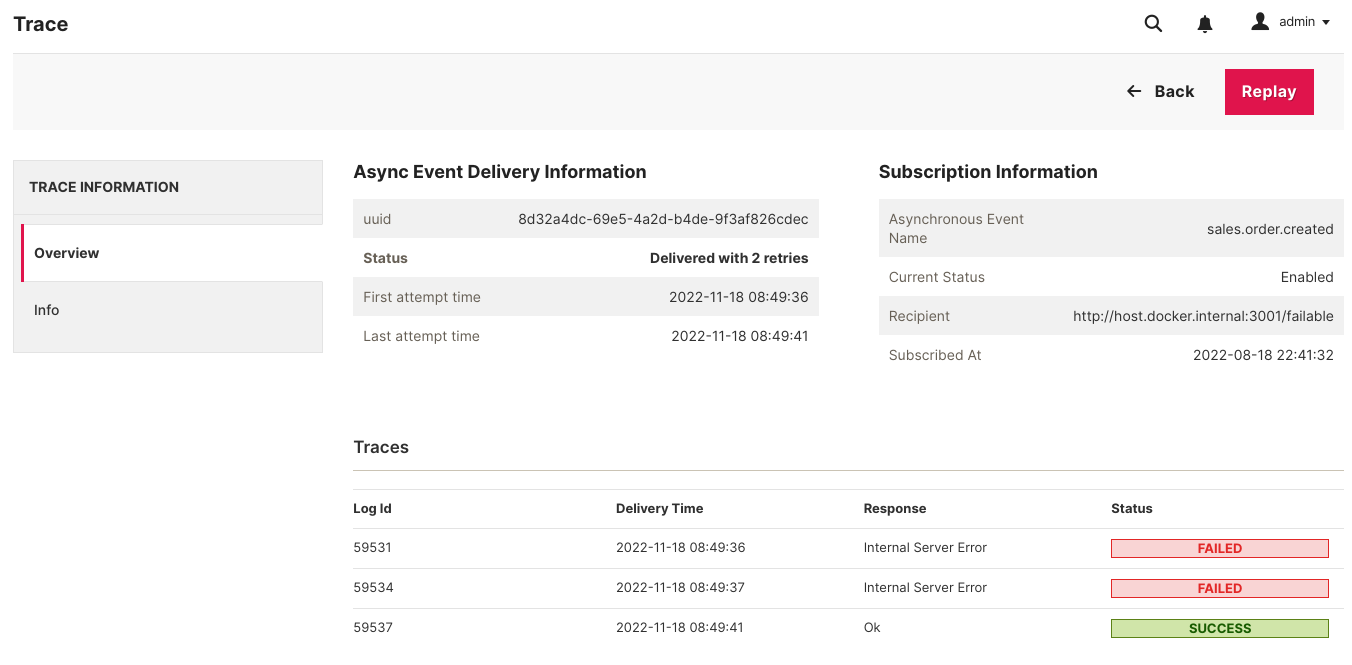
All events are logged at the individual subscription level with a UUID.
All information from the first delivery attempt to the latest attempt is presented as a trace table. The event payload is also available to view for investigation purposes.
Retries
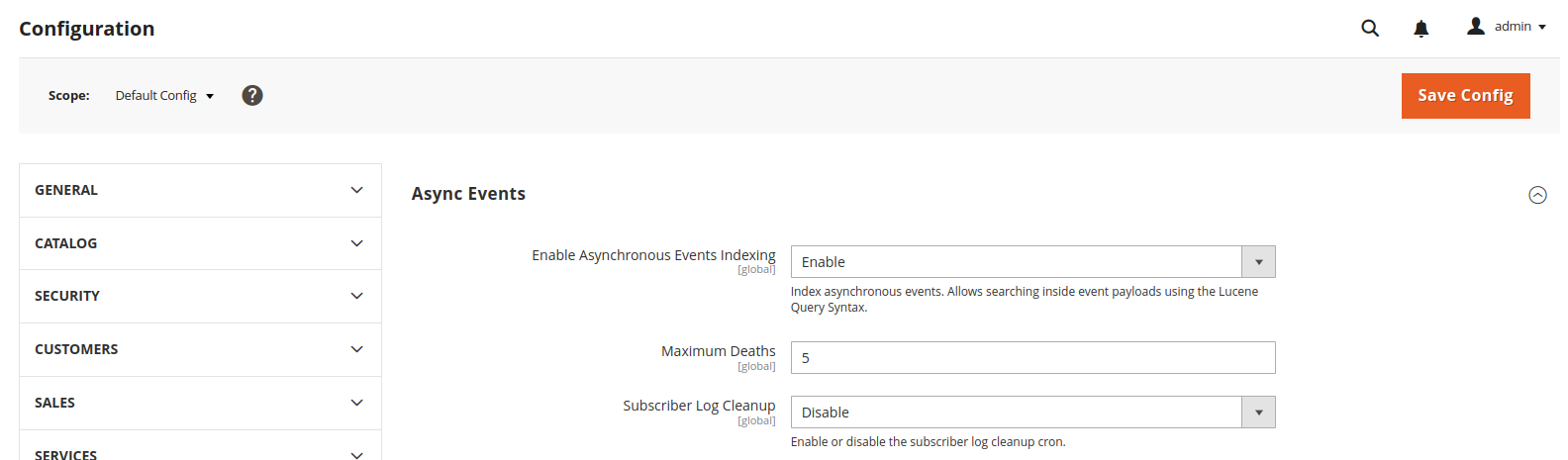
Events are automatically retried with exponential back off. The default retry limit is 5. The maximum backoff is 60 seconds.
The exponential backoff is calculated as min(60, pow($deathCount, 2));
| Attempt | Backoff |
|---|---|
| 1 | 1 second |
| 2 | 4 seconds |
| 3 | 9 seconds |
| 4 | 16 seconds |
| 5 | 25 seconds |
To change the default retry limit visit Admin > Stores > Settings > Configuration > Advanced > System > Async Events and update Maximum Deaths.
Replays
An event can be replayed independent of its status. This is useful to debug or replay an event when all retries are exhausted.
Replays start a new chain of delivery attempts and will respect the same retry mechanism if they fail again.
Lucene Query Syntax
All events are indexed in Elasticsearch by default. This allows you to search through events including the event payload!
The module supports Lucene Query Syntax to query event data like attributes.
The following attributes are available across all asynchronous events.
log_id
uuid
event_name
success
created
The following attributes differ between asynchronous event types.
data
Examples
Assuming you have the following events configured
customer.created
customer.updated
customer.deleted
sales.order.created
sales.invoice.created
shipment.created
shipment.updated
shipment.deleted
You can query all customer events by using a wildcard like event_name: customer.* which matches the following events
customer.created
customer.updated
customer.deleted
You can query all created events like *.created which matches the following events
customer.created
sales.order.created
sales.invoice.created
shipment.created
You can further narrow down using the other available attributes such as status or uuid.
The following query returns all customer events which have failed. customer.* AND success: false
You can combine complex lucene queries to fetch event history and then export them via the admin grid as a csv if you wish.
Searching inside event payloads
Searching an event payload depends on what event you are searching on.
For the following example event payload, four properties are indexed as attributes. Therefore, you can query on
data.customer_email, data.customer_firstname, data.customer_lastname and data.increment_id.
Properties inside array at any level are not searchable.
{
    "data": {
        "customer_email": "roni_cost@example.com",
        "customer_firstname": "Veronica",
        "customer_lastname": "Costello",
        "increment_id": "CK00000001",
        "payment_additional_info": [
            {
                "key": "method_title",
                "value": "Check / Money order"
            }
        ]
    }
}
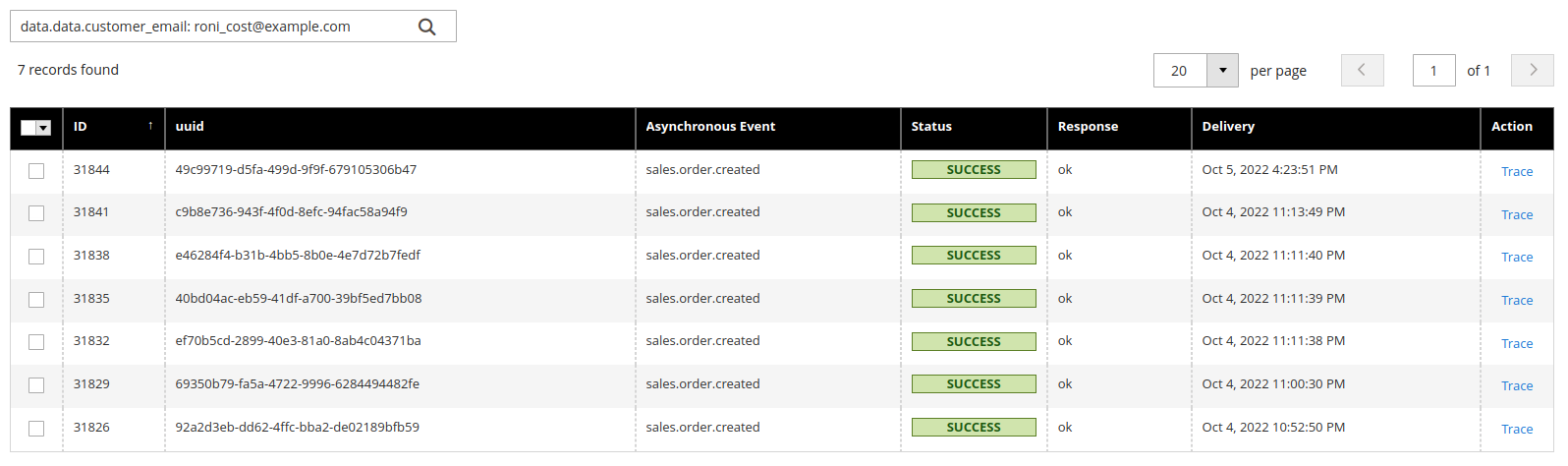
Search all events where the customer email is roni_cost@example.com
data.data.customer_email: roni_cost@example.com
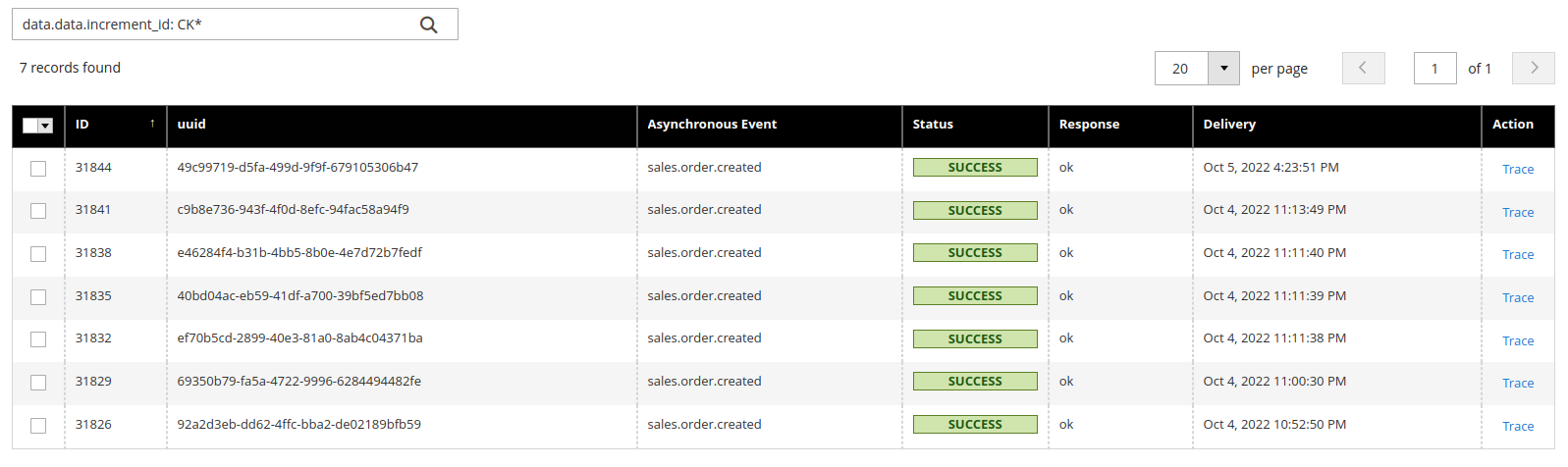
Search all events with the order increment id starting with CK and status success
data.data.increment_id: CK* AND success: true
To turn off asynchronous event indexing visit Admin > Stores > Settings > Configuration > Advanced > System >
Async Events and disable Enable Asynchronous Events Indexing.
This content is fetched directly from the module's GitHub repository. We are not the authors of this content and take no responsibility for its accuracy, completeness, or any consequences arising from its use.